Nine episodes into a season that mostly played it safe, somebody finally did something odd. “It Takes You Away” is a strange, lopsided, genuinely unpredictable hour that starts as Nordic horror, becomes a portal fantasy, spends ten minutes in a cave with a goblin, and ends with a woman having a conversation with a sentient universe that has taken the form of a frog. I have no idea whether it’s good. I’m fairly sure it’s the most interesting thing this season attempted, and after weeks of functional monsters and delivered themes, interesting counts for a lot.
The best opening of the season
The first act is superb and it’s almost entirely quiet. A boarded-up cabin in a Norwegian fjord, no one inside, food on the table, and a blind teenage girl called Hanne alone and terrified. Her father Erik has been gone four days. Every afternoon at the same time a monstrous roar comes from the woods, and she’s been surviving alone by counting steps and timing the noise. Ellie Wallwork is excellent, and the writing around her disability is the best in the season by miles. She isn’t a lesson or a symbol. She’s a frightened, competent, extremely annoyed teenager who has worked out her own survival routine and doesn’t want strangers reorganising it. The show simply lets her be capable. The reveal that the roar is a speaker rigged in the trees, and that her father set it up to keep her indoors while he went somewhere, is a proper gut-punch.
The bit in the middle
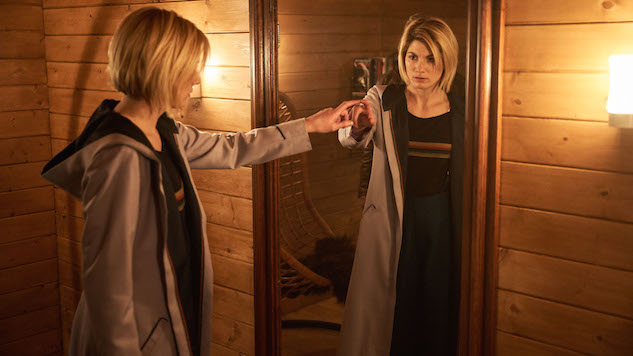
Then there’s a mirror in the bedroom that isn’t a mirror, and the episode goes through it into an anti-zone, and things get scruffy. The anti-zone is a buffer, a cave system between universes, populated by flesh moths and a creature called Ribbons. He’s a grubby, wheedling little smuggler with a lantern, and Kevin Eldon plays him as pure Dickensian nastiness. He’s a fun character with a good design, and the episode has no real use for him. He haggles, he lies, he steals the lamp, and he’s eaten by moths about four minutes after arriving. This whole stretch feels like a different production. It’s the cheapest-looking sequence in the run and it delays the actual story. Whatever budget the fjords ate, the caves paid for.
On the far side is the world the episode is actually about. Erik has been going through the mirror because his dead wife is there. Trine is alive, warm, exactly as he remembers, and he has been abandoning his blind daughter in a cabin to spend afternoons with her. That’s a properly ugly piece of human weakness and the episode doesn’t excuse it. And then Graham turns a corner and Grace is standing there. Bradley Walsh has been the best thing in this season since the first episode, and this is his hour. He knows it isn’t her. He says so, out loud, repeatedly, and he keeps talking to her anyway, because she’s right there and she’s laughing at his jokes. The performance is all restraint: a man being offered exactly what he wants, understanding precisely what’s being done to him, and having to decide anyway. The tell is small and perfect. This Grace wouldn’t climb the crane. The real one did, in The Woman Who Fell to Earth, and it killed her. That’s the moment he knows, and it’s the moment he lets go.

A frog on a chair
The explanation is where the episode either wins you or loses you completely. The mirror world is the Solitract, a conscious universe that was exiled before existence began because its reality was fundamentally incompatible with everything else. It has been alone since before time. It builds worlds and populates them with what people love, because it wants company, and it cannot help destroying anything that stays. The Doctor talks it down in a white void, where it appears to her as a talking frog on a chair, using the voice of a woman Erik loved. It’s absurd. It’s also the only moment in the season where the Doctor solves something by being kind to a lonely thing rather than by identifying a technical weakness, and Whittaker plays the scene with total sincerity. She isn’t defeating it. She’s persuading a desperately lonely entity to let her friends go home, by offering to stay herself, and then being refused because it likes her too much to keep her. I can see exactly why people hate it. A frog on a chair is a hard sell. I’d still rather this show swing at something this weird and half-miss than produce another competent hour about a corporation.
The mirror world that gives back your dead is not a new device, and the episode knows it. This is the Land of Fiction, the Valeyard’s illusions, the Nethersphere, the amber-preserved memory of half a dozen previous stories. Doctor Who returns to the false paradise every few years because it’s a reliable engine: build a version of what somebody wants, then make them choose. What’s different here is the motive. Usually the trap is set by something malicious that feeds on the captive. The Solitract isn’t feeding. It genuinely wants a friend, has no concept of the harm it causes, and lets everyone go once it understands. There’s no villain in the episode at all, which is a startling thing for a season to attempt this late in its run. Ed Hime’s script has a loose, slightly hallucinatory quality that nothing else this year comes close to. It’s the only hour that feels like it was written by someone with a specific sensibility rather than to a brief.
What it fixes
The real function of the episode is Graham, and it works. He walks away from his dead wife, and then Ryan calls him “Grandad” for the first time. That’s the season’s one genuine character arc closing, and it lands because it’s been built patiently across nine weeks rather than announced. The fam remain what’s good here. Everything I’ve liked about this run has been these four people. Every complaint I’ve got is about what was put in front of them.
There’s one persistent irritation, and this is the ninth time I’ve written it. Yaz is present throughout and has almost nothing to do. She helps Hanne, she asks the Doctor clarifying questions, she reacts. Mandip Gill is good in every scene she’s given and the season keeps declining to give her any. Three companions was always going to squeeze someone, and the arithmetic has consistently fallen on her. Graham has the grief and the arc. Ryan has the father and the dyspraxia and the relationship with Graham. Yaz has one excellent episode in Demons of the Punjab and ten weeks of standing slightly to the left of the plot. It’s the clearest sign that the crew size was a decision made for the poster rather than for the writing.
What it leaves behind is Hanne, a blind teenager written as capable and irritated rather than as a lesson, the best guest character of the run. It leaves a speaker in the trees, a father faking a monster to keep his daughter indoors while he visits his dead wife, which is genuinely nasty. It leaves the anti-zone, a cheap-looking detour with a good character in it and nothing for him to do. It leaves Graham and Grace, Bradley Walsh knowing it isn’t her and staying in the room anyway, the best acting of the season. And it leaves a lonely universe, solved by conversation and kindness rather than a technical fix, in the form of a frog, which is ridiculous and sincere and I’m glad it exists.
Rating: 3/5. Wildly uneven, baggy in the middle, and the only episode this season with real imagination behind it. The Norwegian opening is the best sustained sequence of the run and the cave section is the worst. Graham’s goodbye earns the whole thing. Your tolerance for the frog will decide the rest. A cabin, a mirror, and a universe so lonely it built a world just to have someone to talk to. Daft as anything. First time all season I didn’t know what was coming.
