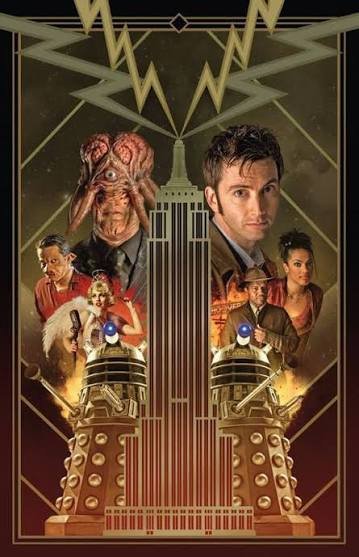
A review of Evolution of the Daleks, the second half of Doctor Who’s 2007 Manhattan two-parter. The post follows Dalek Sec as his human side gives him a conscience, the Cult of Skaro’s mutiny against him, the lightning strike on the Empire State Building, and the fates of Solomon and Laszlo.
It calls Sec’s arc one of the best ideas the show has had about the Daleks and praises Solomon’s death, but finds the hybrid army, the final battle and much of the dialogue weak. The episode is rated 2.5/5, a two-parter admired more than enjoyed.
Last week ended with a squid-headed creature in a Dalek casing declaring itself the future of its species, and I said I couldn’t tell whether that was brilliant or ridiculous. Having watched the resolution, I can report that it’s both, and the proportions aren’t in its favour. “Evolution of the Daleks” has one of the best ideas the show has ever had about its oldest enemy and surrounds it with a muddle. Picking up straight from Daleks in Manhattan, this is a frustrating hour, thoughtful in places and faintly embarrassing in others.
The Dalek Who Felt
The good stuff first, because it’s very good. Dalek Sec, having folded a human into himself, starts changing, and not in the way he planned. He wanted human resilience and human cunning. What he gets is human feeling. He begins to hesitate, he begins to sympathise, and he looks at the plan to hollow out a thousand people and finds, to his own horror, that he doesn’t want to do it any more.
That’s a magnificent idea and it puts a proper tragedy at the centre of the episode. Sec isn’t redeemed exactly, he’s a war criminal having a conscience installed against his will, but he becomes something new, a Dalek arguing that his species has to stop being what it is in order to deserve to survive. Eric Loren plays him with a weary, halting sadness that sells it far better than the costume has any right to allow. His pitch, when he finally makes it, is unsettling coming out of that mouth. A Dalek standing in a sewer arguing that a race incapable of love or doubt or hesitation has already lost, and that the only way forward is to become partly the very thing they’ve spent their whole existence exterminating. Strip away the tentacles and it’s a decent argument, honestly made, which is what makes the rest so grim, because there’s nobody in that room capable of hearing it.
It also rhymes beautifully with the last time this show put humanity inside a Dalek. Back in Dalek a lone survivor absorbed Rose’s DNA, felt something for the first time, and found the contamination so unbearable that it destroyed itself. Sec goes the other way, he embraces it and argues for it, and the result is no less fatal. The show’s position is consistent and bleak either way. A Dalek that feels can’t go on being a Dalek, and its own kind won’t let it be anything else.
Mutiny in the Sewers
Which is exactly what happens. Thay, Jast and Caan watch their leader develop a conscience and diagnose it, correctly by their standards, as a malfunction. The Cult of Skaro was created to have imagination, and the moment imagination produces something that isn’t ruthless, they revolt against it. The mutiny scenes are the best in the episode, Daleks debating heresy in the dark, deciding their commander is no longer pure enough to lead, and chaining him up like a prisoner. When Sec finally dies it’s throwing himself in front of a blast meant for the Doctor, and the Doctor’s reaction is the right one. Not triumph, real grief. An entire possible future for the species, shot by its own side for the crime of hesitating.

The one part of the ending that lands without qualification is Solomon. Facing down the Daleks, he tries the only thing he knows. He steps forward, unarmed, and appeals to them as one living thing to another with a moving little speech about shared humanity, and they kill him mid-sentence. It’s brutal and completely correct, a decent man’s decency counting for precisely nothing, and Hugh Quarshie makes it hurt.
Thay and Jast are destroyed, and Dalek Caan, alone and cornered, throws himself into another emergency temporal shift, the same trick that got the four of them out of Doomsday, and vanishes. The last Dalek in existence, again, gone to who knows when. The Doctor lets him go, and there’s something tired in the way he does it, like a man who’s had this exact conversation too many times to believe it’s the last. And that’s the other thing I kept noticing, how differently this Doctor handles them now. No gloating, no grandstanding, just an offer made flatly and without much hope, and a shrug when it’s refused. Whatever the Time War took out of him, the part that used to relish beating the Daleks seems to have gone with it, and he’s simply tired of them, which is a bleaker place for the show to have got to than any amount of shouting.
Lightning on the Empire State
The plot around all this is where things wobble. The gamma strike arrives, the Empire State Building’s mast does its job, and the Doctor, in a moment of glorious nonsense, clambers up and grabs the conductor at the critical instant so his own Time Lord DNA gets swept into the mix. It’s a huge, silly, wonderfully Doctor-ish gesture, and it pays off in the episode’s best idea. The Dalek-human army, ordered to kill, stops and asks why. Free will, smuggled in on a lightning strike. Daleks undone by a question.
Martha has a very good episode, too. She’s the one up on the mast prising the Dalekanium off before the strike hits, she improvises her way out of trouble more than once, and she spends a long stretch of the hour keeping frightened people together while the Doctor is somewhere else entirely. The self-reliance she found alone in a stolen car in Gridlock has hardened here into something closer to command, and the show barely pauses to remark on it, which is the right call.
Unfortunately the hybrids themselves are a hard sell, men in period suits doing stiff Dalek voices and gunning each other down, and the climactic battle never looks like anything other than a handful of people in a corridor. The episode’s ambitions keep outrunning what it can actually put on screen. Slice of SciFi called it a good idea stretched a bit thin, and that’s about where I landed too. There’s a warmer coda for Laszlo, though, whose half-converted body is failing until the Doctor improvises a fix, and who gets to walk back into Hooverville with Tallulah and be taken in by the people there. After an hour of grim arithmetic, one man getting to keep his life is a decent note to go out on.
Rating: 2.5/5. It carries the season’s most interesting single idea and fumbles nearly everything around it. The Sec material and Solomon’s death are strong, the hybrid army, the final shootout and a good deal of the dialogue are not. A two-parter I admire more than I enjoyed.
A Dalek who learned to feel and was executed for it, and a man in a shanty town who died talking about peace. There’s a very good episode buried in this one. It just keeps getting interrupted by men in suits shouting “exterminate.”
