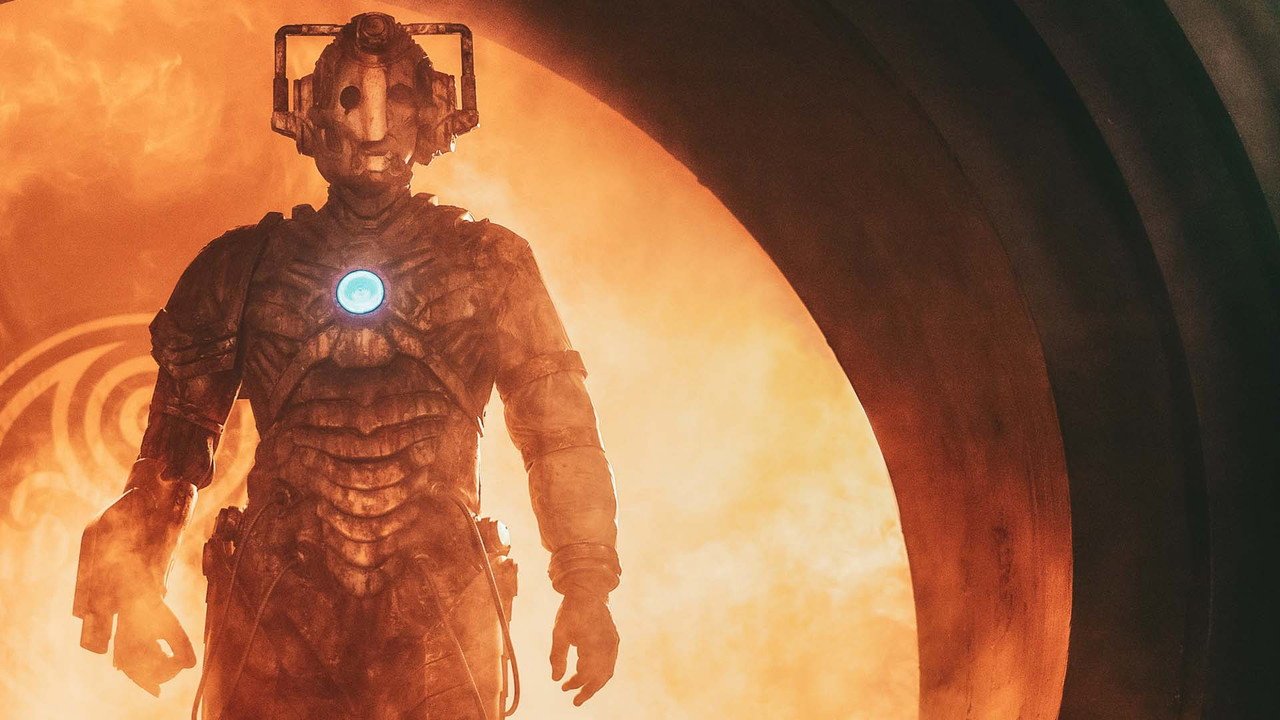
I have been dreading writing this one, because I want to be fair to it and I am not sure I can be. “The Timeless Children” takes the oldest and best-kept space in Doctor Who, the part of the Doctor’s history the show has spent nearly sixty years deliberately not filling in, and fills it in. It does so at length, in a single unbroken lecture from the Master, using clips and flashbacks and a lot of standing about in the Matrix, while a Cyberman invasion happens somewhere off to the side. As a piece of television it is inert. As a decision about what this programme is, I think it is the worst one anybody has made.
The lecture
The mechanics first, because the shape of the thing is the problem before you even get to the content.
Roughly half the runtime is the Master explaining. He walks the Doctor through the Matrix and narrates her own history at her, and she stands there and receives it. There is no investigation, no working out, nothing she does to earn any of it. The most important information in the character’s life is delivered as a monologue by somebody else while she is held in place.
The content is this. A Gallifreyan explorer called Tecteun found an abandoned child at a boundary, discovered the child could regenerate, and experimented on her repeatedly to work out how. Regeneration was harvested from that child and spliced into the Gallifreyan genome, which is where the entire Time Lord species got it from. The child was then wiped, given a fresh identity, and put to work for a secret agency called the Division. That child is the Doctor. She is not a Time Lord. She is the source of them, she is far older than she has ever known, and she has lived an unknown number of lives before William Hartnell.
Sacha Dhawan does everything possible with it. He is gleeful, unstable and clearly wounded by his own findings, and he is the only reason the sequence holds together at all. Jodie Whittaker is given almost nothing to play except reception. There is one good moment near the end, in a fantasy of her own making, where she refuses to be defined by any of it, and it is not enough to carry forty minutes of being told things.
Why it damages the show
My objection is not that the lore changed. Doctor Who has rewritten itself constantly and I have no interest in defending continuity for its own sake.
The objection is that this trades something valuable for something worthless. What the Doctor has always been is a person who ran away. An ordinary member of a stuffy, rule-bound people who stole a museum piece and left, and whose entire significance comes from what he chose to do rather than from what he was. That is a genuinely radical idea for a hero and it is the reason the character works. Anybody could decide to be that. The show has said so, out loud, more than once.
Replacing that with a secret chosen-one origin, in which the Doctor was always special, always the source, always the most important being in the room, is the single most conventional move available. It takes the one hero in popular fiction who was not the product of a prophecy or a bloodline and gives him one. And it does not enable a single story that could not have been told before. Nothing in the following years needed this. It is a fact, delivered, and then the programme carries on much as it did.

There is a smaller loss too. The unknown was doing work. Not knowing where he came from, or why he left, or what he did before the junkyard, gave the character a floor you could not see the bottom of. The Wedding of River Song made a whole finale out of the idea that the oldest question in the universe was simply his name. Answering the unanswerable does not deepen a mystery, it closes it. Reaction at the time was fierce, and fan sites like Doctor Who News were still running argument pieces about it months later.
There is a defence of all this that I want to take seriously, because plenty of people make it. The argument runs that the Doctor rejecting the information is the point, that what matters is her insisting she is defined by her choices rather than her origin, and that the show therefore has it both ways. I do not think that holds. If the answer genuinely does not matter, then spending an entire finale delivering it is a strange use of the time. And the show does not treat it as unimportant afterwards. It comes back, repeatedly, as the defining fact of the era. You cannot introduce something as the biggest thing in the character’s life and then claim it was always beside the point.
The other defence is that mystery has been restored rather than removed, since we now know there are lives we have never seen. That is a different kind of mystery and a much weaker one. Not knowing where the Doctor came from was an open door. Knowing there are unspecified adventures in an unspecified gap is a filing cabinet. One invites you to imagine. The other just tells you there is more paperwork.
Everything else in the episode
There is a Cyberman invasion in here somewhere and it deserved better.
Ashad, the finest villain the era produced, is killed off-hand by the Master about a third of the way in and replaced with Cyber-Time Lords, which is a design that sounds impressive and looks like Cybermen wearing collars. Patrick O’Kane built something genuinely frightening across two episodes and it is thrown away in a moment to make room for more talking.
The fam are stranded in a plot of their own with the last surviving humans, running corridors and setting explosives, and it is competent and completely disconnected. Graham’s speech to Yaz about how remarkable she is, is the warmest thing in the hour and the only scene with any human weather in it. Bradley Walsh has been the best thing in this era from the first episode to the last.
The resolution is where it collapses entirely. The Doctor is handed a Death Particle that will destroy all life on Gallifrey, decides she cannot do it, and then Ko Sharmus, a man we met last week, takes it from her and does it for her. The lead character is removed from her own climax so that a guest can resolve it. She is then arrested by the Judoon and imprisoned, which at least sets up somewhere to go next.
What it leaves behind is a Doctor who used to be a person who ran away and is now a person who was always chosen. It leaves Sacha Dhawan, doing everything humanly possible with forty minutes of narration, and Bradley Walsh finding the only genuine warmth in the hour. It leaves Ashad, the era’s best villain, discarded in a moment. It leaves a finale where the lead stands still while somebody else explains her, and then a stranger makes her decision for her. And it leaves a question that was better unanswered, answered.
Rating: 1.5/5. Structured as a lecture rather than a story, it removes its own hero from the climax, throws away its best villain, and spends its running time dismantling the most interesting thing about the character it is built around. Dhawan is superb and Bradley Walsh is a comfort. Everything else here I would give back.

4 comments
[…] in a run of finales that beat an enormous threat with a gimmick rather than a cost, going back to The Timeless Children and its season of questions answered with something nobody could act on. The pattern is now […]
[…] encouraging, because the questions are all about identity and parentage, which is exactly where The Timeless Children went. A mystery works when the character at the centre is chasing it, the way Clara kept turning up […]
[…] nothing about what she did for Division, which is the far more interesting question and the one The Timeless Children actually raised in the first place. A Doctor who was an operative for an organisation that meddled […]
[…] thread I actually care about is Division, and it gets maybe four minutes. After The Timeless Children rewrote the Doctor’s entire history, and she then spent Revolution of the Daleks doing very […]