
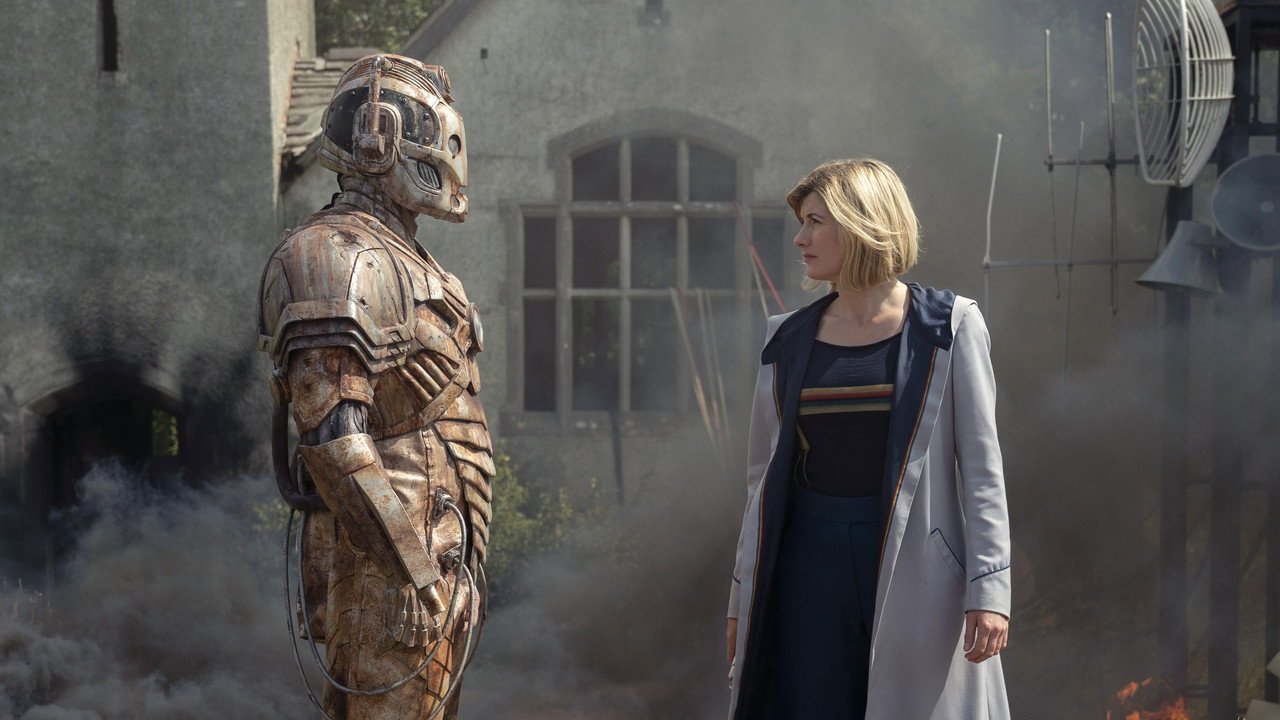
For about forty minutes this is the bleakest and most effective thing the era attempted. The Cyber-Wars have been fought and humanity lost. There are seven human beings left in the universe, hiding in a camp on a dead world, and the Doctor arrives with a plan and a handful of improvised defences and watches all of it fail inside five minutes. That is a genuinely bold opening for a penultimate episode, and the first two thirds of “Ascension of the Cybermen” are as tense as this show gets. Running underneath it, in black and white, is a story about an Irish policeman that has nothing to do with anything, and what that story turns out to mean is the reason I cannot rate this higher.
Losing, properly
The strongest thing here is that the Doctor is beaten from the first scene and stays beaten.
Her defences are swept aside immediately. The survivors are scattered across two ships with no way to contact each other. Graham and Yaz end up aboard a Cyber-carrier full of dormant warriors, hiding in a rack of empty suits while Cybermen power up around them, and it is the most sustained tension the era generated. Bradley Walsh and Mandip Gill play the whole sequence in near silence and it works far better than any amount of running.
The design work has stepped up too. The new Cyber-warriors have battle damage, cracked faceplates, human skulls visible through broken helmets, and the show finally gets that a Cyberman is more disturbing the more you can see what it used to be. The flying Cyber-heads are a genuinely nasty idea, small and fast and worse for being incomplete.
Patrick O’Kane remains superb. Ashad is now a zealot rather than a wounded man, preaching to a fleet that has not woken yet, and his contempt for the “half-forms” who did the conversion badly gives the character an edge nobody else in the era has. He is a Cyberman who believes, which is a contradiction the show has never really used before.
Ko Sharmus, the guardian of the boundary, is well played by Ian McElhinney and gives the survivors somewhere to run towards. The bleakness is maintained: people die, the plan does not work, and the episode is content to let the Doctor be out of ideas for most of its runtime. After Praxeus and its tidy antidote, watching this show fail at something for a full hour is welcome.
The Irish policeman
And then every ten minutes we cut to Brendan.
A baby found on a roadside in rural Ireland, adopted, grown, joining the Garda. Shot off a cliff by a robber and getting up unharmed. Serving out a long career and then, at his retirement, being strapped into a chair by his father and his old sergeant, neither of whom have aged a day, and having his memory wiped by a machine.
Taken on its own this is well made. It is shot like a different programme, warm and grainy where the main story is cold, and the retirement scene is properly unsettling. The trouble is that it has no visible connection to anything. For most of the episode you are watching two unrelated stories and waiting for the join, and the join does not arrive within this hour at all. As a piece of construction that is a gamble, and it only pays off if the eventual answer is worth the wait.
It is not. What Brendan turns out to be is the first move in the Timeless Child business, and I have already made my feelings about that plain going back to The Ghost Monument. Watching these sequences now, knowing they exist to set up a rewrite of the Doctor’s origin that I think the programme should never have attempted, drains them of whatever intrigue they had first time. They stop being a mystery and start being a delivery mechanism.

It is worth noting how much better the Cybermen work here than they have in years, because it is not an accident. The show has stopped treating them as an army and started treating them as a weapon that has already been used. The war is over. These are the survivors of the thing that won, and most of them are asleep, which means the episode can put its characters inside a room full of them and generate dread without a single one moving. Fear of a dormant enemy is a far better use of a Cyberman than another squad marching down a corridor announcing deletion.
The survivors are thinly drawn, and that is the one place the writing lets the premise down. When there are seven human beings left alive in the universe, each of them ought to feel irreplaceable, and instead they are largely interchangeable and die in an order determined by the plot rather than by anything they do. Ethan and Ravio get a little colour. The rest are there to be lost. An episode this bleak needed us to know exactly who was being spent.
A cliffhanger that promises the wrong thing
The last five minutes are enormous and I remember being genuinely excited by them.
The survivors reach the boundary. The Master steps through it. Gallifrey is in ruins behind him, and he tells the Doctor that everything is about to change, and the episode ends. Sacha Dhawan is electric in the thirty seconds he gets, and as a hook it is one of the best the show has done in years. The Cybermen are ascending, the Master is loose, and the answer to the season’s mystery is one week away.
That is the difficulty with writing about this episode honestly. As broadcast, week to week, it worked. It is well made, it is bleak in a way this show is usually too polite to attempt, and it sets up its finale with real momentum. The BBC’s own programme page still lists it among the era’s highlights and I can see why. But a penultimate episode is a promise, and this one is promising something I would rather it had not delivered.
Watched purely as an hour of television, with no knowledge of what follows, this would sit close to the top of the era. That is an uncomfortable thing to admit about an episode I have just spent several paragraphs criticising, but it is true, and it says something about how much a finale can retroactively cost the episode that set it up. The craft here is genuinely good. The problem arrives seven days later.
What it leaves behind is a universe where humanity has already lost and seven people are all that remain, which is as dark a premise as the show has used. It leaves Graham and Yaz hidden in a rack of empty Cyber-suits, the tensest sequence of the era. It leaves Ashad as a believer rather than a victim, and Patrick O’Kane making a zealot out of a machine. It leaves Brendan, well acted and well shot and entirely disconnected, waiting to explain himself. And it leaves the Master stepping out of a ruined Gallifrey to tell the Doctor that everything she knows is wrong.
Rating: 3/5. Bleak, confident and genuinely tense for two thirds of its length, with the best Cybermen the show has fielded in decades and a Doctor who spends the hour losing. The Brendan material is a real gamble that the following week does not justify, and knowing where it leads takes the edge off a story that otherwise had me. Very nearly the era’s second-best hour.
