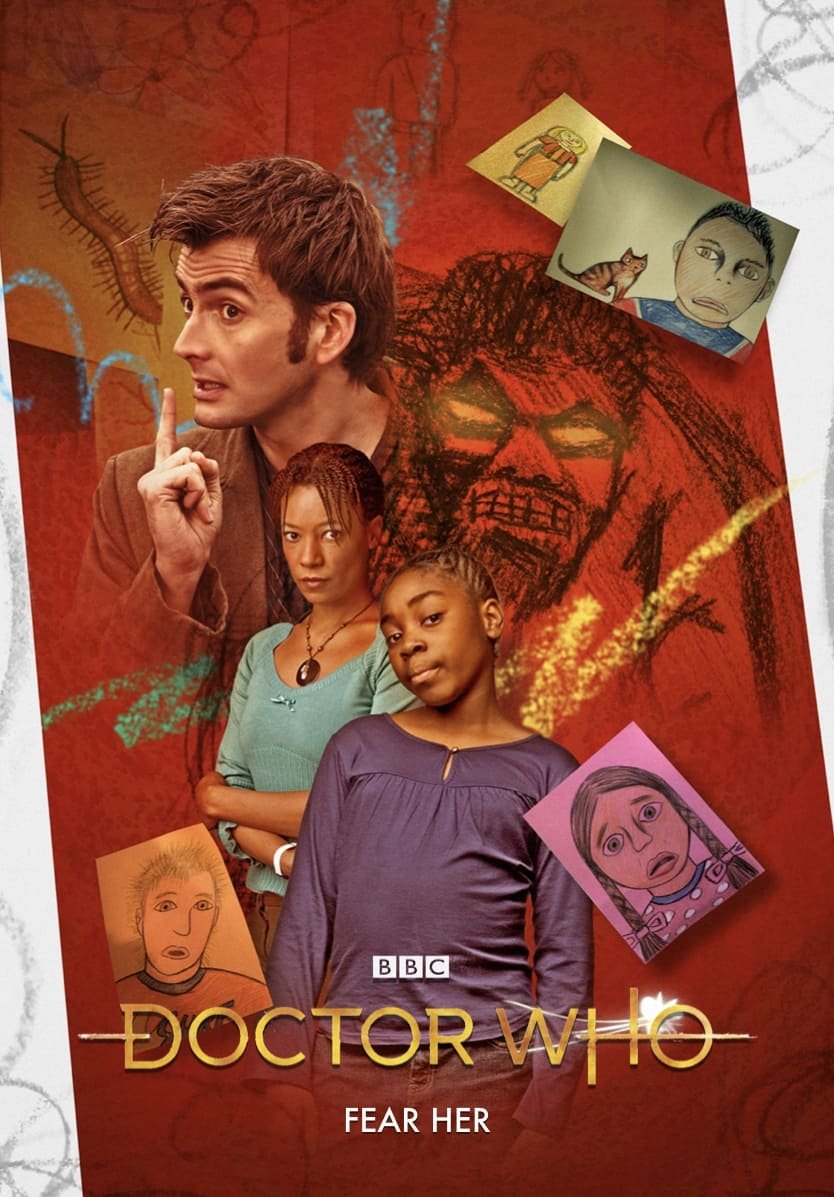
This review covers “Fear Her,” the eleventh episode of Doctor Who’s second series, in which the Tenth Doctor and Rose Tyler investigate a wave of child disappearances on a London housing estate on the eve of the 2012 Olympics. It traces the episode’s premise, a grieving, isolated alien reaching out through a lonely girl’s drawings, and the darker thread underneath it: a dead, abusive father reimagined as a literal monster in the girl’s wardrobe.
The piece argues the episode is at its best when it stays small and human, and loses its footing in a stadium-sized climax built around an Olympic torch and a surge of collective love. It rates “Fear Her” 2.5 out of 5, calling it the weakest entry of the season despite a strong central idea and the easy chemistry between its two leads.
After the grand experiment of Love & Monsters, Doctor Who scales right back down for “Fear Her,” a small, domestic, child’s-eye story set on a single suburban street. It’s the most modest episode of the season by a distance, and if I’m honest, the weakest. But there’s a gentle, well-meaning heart beating under its wobblier moments, and even minor Doctor Who has something going for it. Let’s talk about the one that doesn’t quite come together.
The Girl Who Draws
The TARDIS lands in London in the near future of 2012, on the very day the city is due to host the Olympic Games. On an ordinary little residential close, though, something is badly wrong: children are vanishing into thin air, snatched from the street in broad daylight with no trace, and the neighbourhood is gripped by a quiet panic. It’s a nicely observed bit of ordinary dread: net curtains twitching, parents keeping their kids indoors, a council worker convinced there’s a predator stalking the close. Doctor Who is often at its best when it drops the fantastical into the utterly mundane, and a sunny suburban cul-de-sac where children simply evaporate off the tarmac is a promising place to start. Rose handles much of the early legwork, knocking on doors and piecing the pattern together while the Doctor frets over his readings, and their easy division of labour is a pleasure to watch. The Doctor and Rose arrive to investigate, and the trail leads them to a house, and to a twelve-year-old girl named Chloe Webber.
Chloe, it turns out, is the cause, though not by choice. She’s become the host to an Isolus, a member of an alien species that travels the cosmos in vast family groups of billions, drifting together on waves of shared love and warmth. This particular Isolus was separated from its siblings and crash-landed on Earth, marooned and utterly, achingly alone, and it has latched onto a lonely little girl who understands exactly how that feels. Together, through Chloe’s drawings, they’ve been reaching out for company in the worst possible way. Whatever Chloe draws becomes trapped in the picture: the missing children are all there, alive but frozen in two dimensions, pinned to the paper like specimens. It’s an eerie, genuinely creepy central idea, and the best thing the episode has going for it.
Fear in the Wardrobe
The stronger, darker thread is what Chloe fears. Her father is dead, but he was a violent, frightening man, and her terror of him is so raw that the Isolus’s power has given it form. Something scribbled and monstrous lives in her wardrobe, a childhood nightmare of an abusive parent made real, growling her name in the dark. It’s an unmistakable echo of the domestic dread Mark Gatiss mined so well with Eddie Connolly back in The Idiot’s Lantern, and it gives “Fear Her” its most affecting material: a child haunted, quite literally, by the shadow of a bad father, and a mother, Trish, quietly carrying the guilt of not having protected her sooner. Reviews written that same week made the same comparison between the two episodes, and several ranked this one as the stronger of the pair.
When the episode stays small, frightened and human, there’s real feeling in the idea of a lonely alien and a lonely child recognising each other, and in the notion that the monster in the wardrobe is the one horror the Doctor can’t just reverse-engineer his way past, because some fears you have to face rather than solve, the same bet the Doctor staked everything on a few weeks back in The Satan Pit, when faith did what reason couldn’t.
There’s a real tenderness in how the episode treats the Isolus, too. It isn’t truly a villain; it’s a frightened child that lost its enormous family and simply wants to stop feeling so alone, lashing out only because it doesn’t know any gentler way to reach for love. That ache, a lonely thing desperate for connection, rhymes quietly with the loneliest man in the universe standing right there in the room, the very solitude the show laid so bare in The Girl in the Fireplace. The Doctor, of all people, ought to understand exactly what this creature is going through.
The Torch and the Trouble
Where it wobbles is the plot machinery, and the climax in particular. Growing desperate, the Isolus has Chloe draw the entire Olympic stadium: eighty thousand spectators gone in an instant, vanished mid-cheer into a child’s sketchpad. The Doctor works out that the Isolus needs two things to launch its pod and go home: intense heat, and an overwhelming surge of love and togetherness. And wouldn’t you know it, there’s an Olympic torch and a stadium full of hope passing right by. The Doctor ends up scooping the dropped torch off the ground and carrying the flame himself, beaming, as the pod reignites and every trapped soul comes flooding back.

It is… a lot. The torch business is earnest to the point of being hokey, the resolution leans hard on a warm-fuzzy convenience, and the child performances, while sweet, aren’t quite strong enough to carry the emotional weight the script piles onto them. It’s the sort of ending that wants to move you and mostly just makes you smile and wince at the same time. The threat evaporates a little too neatly, and for all the creepiness of the setup, the payoff never quite delivers on it. It doesn’t help that there are a few frankly baffling small beats scattered through: a possessed cat, a scribble-monster that looks more silly than scary once it’s in full light, an eighty-thousand-strong crowd that pops back into existence without anyone appearing to notice they were ever gone. These are the visible seams of a script that ran short on both time and budget, and unlike the best hours of the season, “Fear Her” can’t quite hide the join.
Still, there’s something to the final beats: Chloe and Trish banishing the last of the scribble-father not with technology but by holding onto each other and refusing to be afraid. Love as the thing that beats the monster is peak Russell T Davies-era Who, even in an episode he didn’t write, and it lands more gently than the torch nonsense that precedes it.
The Moment That Actually Lands
What actually stays with me isn’t the torch or the stadium. It’s the small scene right after, where Trish finally gets to tell her daughter she’s sorry without a scribble-monster in the room to interrupt her. Child actors carrying material this heavy is always a gamble, and Abisola Agbaje doesn’t land every beat the script hands her, but that one scene works because for once it’s small enough for a young performer to actually hold. It’s a small mercy the episode almost doesn’t earn, tucked in after all the noise of the torch and the crowd, and it’s the one moment where Trish stops being the worried mother the plot needs her to be and just gets to be her daughter’s mum again.
Rating: 2.5/5 — The weakest of Series 2 for me: a promising, creepy idea let down by a soft plot, uneven young performances, and a climax that tips over into cheese. The domestic-fear thread and the leads’ chemistry keep it watchable, but only just.
And yet it ends on the oddest note. Right at the close, out of nowhere, the Doctor goes quiet and uneasy, murmuring about a storm approaching, a chill that comes from nowhere and settles over the last shot. I’ve no idea what he means by it, and the episode offers not a single clue. But it gave me goosebumps in a way the preceding forty-odd minutes never quite managed, and now I can’t stop turning it over. Whatever’s out there, the Doctor plainly feels it coming, and for the first time all episode, so did I.

1 comment
[…] has the confidence to end on a hug rather than a countdown. There’s a clear family resemblance to Fear Her, another lonely child bending reality around a domestic fear, but this is much the better version, […]